Sunday, June 2, 2013

Dia das Crianças

HAPPY 5th ANNIVERSARY CACHES!

CACHES celebrated Dia das Crianças on June 1st. And the 5th anniversary as an association. PARABEMS! 
Just some highlights from the day...
Mae, Judite and some of the other kids writing out the rights of children on balloons to share with the rest of the group.
TINA!!!


It wouldn't be a party at CACHES without a dance session.


Some of the kids putting the finishing touches on their kites.

Kites! We made kites using what we had: plastic bags, reeds and rice sacks.

Judite and her kite on the main road in Chicumbane.


Lola, Inocencia and Sheila getting ready to dance.

LANCHE!

Joao and Nelio performing a theater skit for the kids about the rights of children.

Chicumbane Entertainment, a local music group, came and sang their hit, "Chicumbane".
Junior say along knowing all the words.
Future members of Chicumbane Entertainment.


The gals.
The boys.


AMIZADE

Tuesday, May 21, 2013

One Year.


June 1st marks one year in Mozambique. Ep pah! Where did the time go? To summarize the past 365 days, here are a few highlights from the day-to-day...

1.       Dancing—whether in the rain in my yard, at a wedding or at CACHES, it always proves to be a good time.
2.       Making peanut butter with the activistas at Tshembeka. As the maes literally were licking the peanut butter from their elbows, I could tell they loved it as much as I do.
3.       English lessons with the activistas at CACHES—All of them, but one in particular, always get so excited when he gets something right. He starts clapping and says, “Yes, Yes. I am learning.” It makes me smile every time.
4.       Puppies—Between finding them in the sinking latrine, to leaving them when I was evacuated for the floods, to giving them all away, it was quite the adventure for Mel and me.
5.       House-sitting in Inhambane City for a week. A week of food, fun and friends. We lived the dream that is the every day day-to-day of the PCVs in Inhambane City.
6.       Mambas soccer game in Maputo. Vuvuzela and all!
7.       Banana week—when Nelio showed up at my house with a branch of bananas and listed off all the things he wanted to make. Banana bread, banana pancakes, banana crumble, banana jam, chocolate-covered bananas, banana parfait. The whole week was BANANAS!
8.       Halloween at CACHES—Despite realizing that bobbing for apples probably wasn’t the most sanitary game to be playing as a health volunteer, it was a fun cultural exchange for all.
9.       Chicumbane Entretanamento music video—Some of the guys I work with are also part of a music group called Chicumbane Entretanamento and just last month they showed their music video at the one bar in town. It reminded me of a 90’s Boys II Men video. It was a riot.
10.   Homestay cooking day in Namaacha—Complete with killing a chicken, making banana bread and guacamole with my host family.Too bad my family was more excited about the chicken killing than the guac.
11.   Easter Egg Hunt—It was all fun until I realized some of the neighborhood boys helping me hide the eggs took the game a little too seriously as they started hiding the eggs in the sand making it impossible for the kids to find. But in the end, everyone got an egg and were just happy about that!
12.   Swearing in as a PCV—Despite how terribly we sang the Mozambique national anthem, the day was a really nice celebration of finally becoming a PCV.
13.   Mango season—Here in Mozambique, fruits are always in season, but hands down, mango season is the best. And once mango season hits, then its pineapple, then avocado, then tangerines. Doesn’t get much better than that!
14.   Snail mail and care packages. Without fail, a letter or care package always makes my day.

And along with all the highlights, there have been some blue days. But, with those blue days, there are always some life lessons learned. As I have continued to say, I have been learning every step along the way of this journey that is Peace Corps. But some of the greatest lessons I have learned are...

1.       Don’t count your chickens before they hatch.
2.       Live simply.
3.       Presentation is key—whether we are talking about raking the sand yard or my host mom insisting that I clean my sneakers that are just going to get sandy again, how you present yourself is extremely important.
4.       The beauty of just sitting and being with people.
5.    Dependence on the land. Hours a day are spent in the garden just to be able to put food on the table at night.
6.       Tudo bem? Are things really tudo bem (all good) when people say they are?
7.       Family is really important and people are very interested in your personal life. "Why don't you have kids yet?" "Well, you'll just have to marry here in Mozambique." "What do you mean you don't have a boyfriend?" "Just change your nationality to Mozambican."
8.       Importance of lanche--lanche is the beautiful thing that is snack usually around 10 a.m. and sometimes offered at 3 p.m. when you attend conferences or workshops. If lanche is not served, people will get a little hangry (hungy-angry). And once you get into the routine of having lanches, you expect it, get a little hangry yourself and miss it when you don't have it.
9.       People are thankful for any gift you give and when they are willing to give whatever they can in return, they do.
10.   Importance of speaking the local language, even if it is just a couple words like "Lixchile" "Kanimambo" "Salani", they will say,”Voce fala.” “You speak.”
11.   Behavior change is hard. Mozambicans often have a certain way of doing things and that is the way it is done. Introducing new ideas or ways of doing something takes time, patience and dedication.
12.   "Job" has many meanings, people use this term to refer to anything from just going to do homework or going to the market for someone or going to the office to work.
13.   Cheese—there are just some foods you will always really miss. A lot. And when you can have them in the capital or on vacation, you eat them in abundance. To the point of making yourself sick.
14.   The Importance of planning ahead. Period.
15.   Honesty—Mozambicans are blatantly honest, but at the same time, they have no problem lying to you. For example: "Colleen, today you look really pretty. You should wear this more often. But, that long gray skirt you have, that's ugly. Don't wear that." or "Where were you?" "I came by your house, you weren't there." When in fact, I was there the whole time.
16.   Formality of the culture here—Everything has to be presented in a formal letter and documents need to be stamped in order to have credibility. Don't even think about approaching a chefe without a letter prepared as such.
17.   You can’t have tea without sugar or bread. So it is really odd that I don’t drink tea and just drink hot water. Mozambicans ask so many questions every time. So in return, I ask them about the three tablespoons of sugar they are adding to their tea. But, those three tablespoons seem to be the norm.
18.   Ferias—Between December and February do not expect anything to happen. It is the time of holidays and will be a little ways into the new year before things get going again. So just sit back, relax and enjoy the ferias yourself.  
19. "Do you pray?" Mozambicans are really concerned if you pray. It doesn't necessarily matter where you pray, just as long as you are doing it. 
20.   Never leave home without a capalana—It is very versatile and can become a sweat towel, an umbrella, a cover for your knees, the possibilities are endless.

Saturday, April 27, 2013

World Malaria Day

Malaria is the number one killer in Mozambique. Chicumbane is located close to the Limpopo River, a prime breeding ground for mosquitoes and malaria. Several of my neighbors have had malaria since I have been here. Often when someone complains of having cold or feverish symptoms, it is often assumed it is malaria. Just last week, my friend Dario, a German volunteer working here in Chicumbane complained of a fever, sweats and chills, a headache and a lack of appetite. I did a malaria rapid test with him at his house and it was positive. We went to the hospital, where we did another test and again it was positive. We then were able to go to the pharmacy to pick up Coartem for him. He has been getting better over the past few days. He was lucky in that we were able to test for it and get him the medicine he needed. It doesn’t come as a surprise here when someone says they have malaria. But, the consequences are extremely serious and life-threatening. While many people are aware of the severity of malaria, they are ill-equipped to protect themselves. They know they should sleep under a mosquito net, but lack the money to buy a net. The hospital only gives out nets to pregnant women.


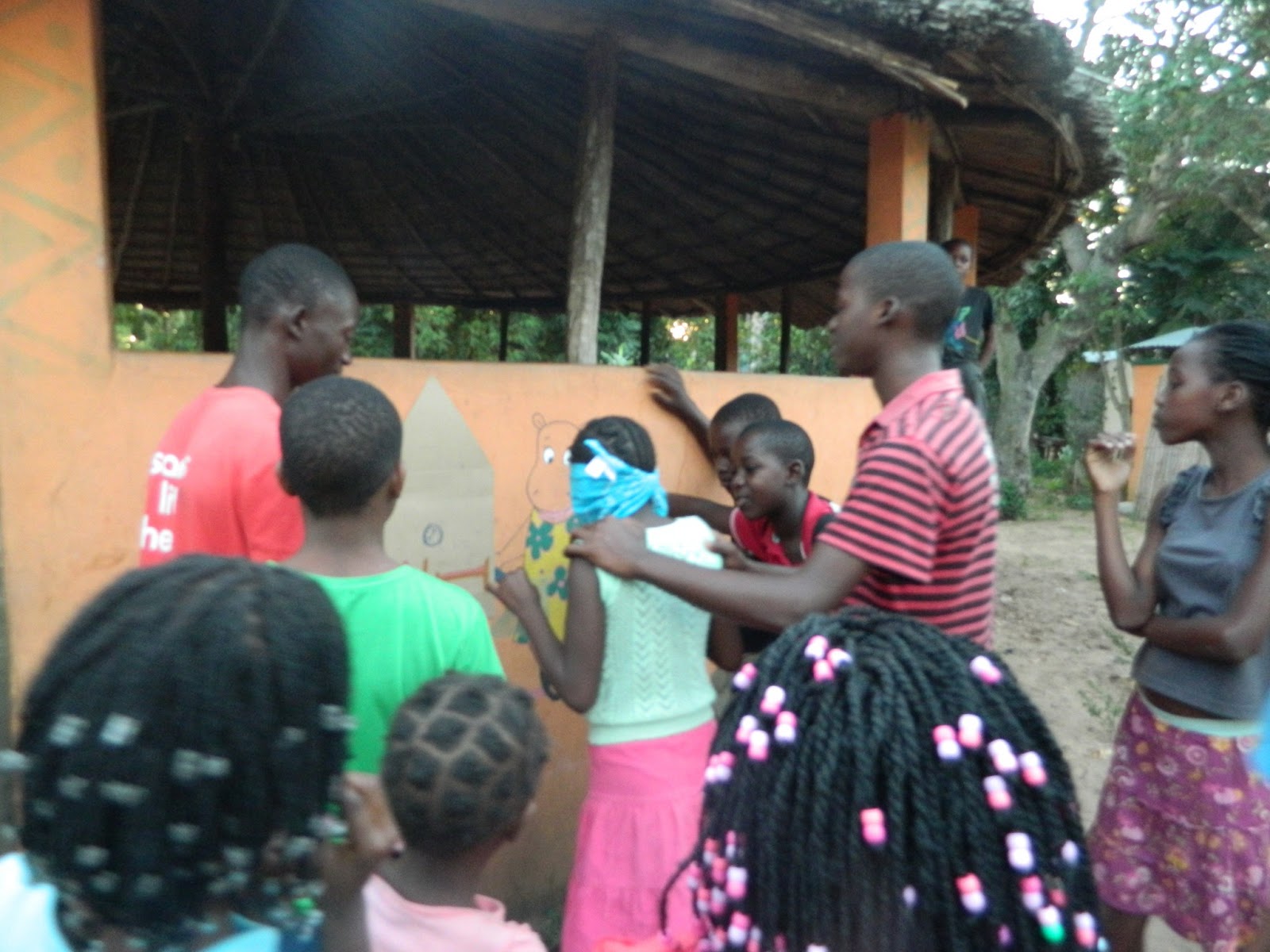
In order to raise awareness, throughout the month of April, I worked with one of the volunteers at CACHES to discuss a different aspect of malaria each week. We covered the following topics: What is Malaria, Prevention, Signs and Symptoms and Treatment. On April 25, World Malaria Day, we did several activities to summarize the lessons for the month. First, three of the other volunteers led a discussion of malaria covering the four topics. Then we played a few games. We played mosquito tag, where there was one mosquito who was trying to “tag” the other kids. Kids were “safe” from the mosquito if they were underneath the mosquito net being held up on two sides of the yard. If one of the kids was tagged by the mosquito, they too became a mosquito and could tag other kids. We then played “Pin the mosquito net on the bed”. Adopting the rules from “Pin the tail on the donkey,” I drew a house with a bed and then distributed pieces of mosquito netting. Each of the kids had to try to place the net over the bed, and whoever was the closest to covering the whole bed, won. And then, we had a mosquito piñata. Before we started, we talked with the kids about how when they see a mosquito, they should hit it. So we would be hitting this mosquito piñata. I learned from the last time we did piñatas at CACHES not to fill it with candy, so I just filled it with paper and then distributed the candy afterwards. It was a much better situation for everyone involved.


While we spent the majority of World Malaria Day talking about the importance of protection from mosquitoes and sleeping under a mosquito net, when we asked the kids how many sleep under a mosquito net, just a handful raised their hands.  The volunteers stressed how the kids should go home and tell their parents they want a mosquito net and will sleep under it. But that also requires having the money to buy a net. Ideally one day, all of them would have a mosquito net to sleep under…and together we will STOMP OUT MALARIA. 

Wednesday, April 3, 2013

Easter Weekend

Easter Weekend in Chicumbane...no Cadbury mini eggs, Peeps or Easter baskets. But, we did have  a traditional spirit ceremony and neighborhood Easter Egg Hunt. Instead of ham, we had goat; instead of chocolate, we had hard fruit candies; instead of plastic eggs, we painted egg cartons and instead of the Easter Bunny hiding eggs, it was "Mana Colinda" and some of the neighborhood teenagers. Happy Spring! (Well, really it is just the start of fall here, but ta bom, cooler days are on the way...)

My tutor invited me to a traditional spirit ceremony at her house...
Some said it was to call the dead. Some said it was the traditional medicine doctors' traditional graduation. Some said it was spirit ceremony. All three in one? I still do not 100% understand what was going on exactly, but there are some things you will never understand right?


The ceremony started with the traditional medicine doctors running to find a hidden object. It was said that this was part of their graduation of training to become a traditional medicine doctor so if they were able to find the object, they would graduate. 

A traditional medicine doctor. 
Everyone dancing!


There were just enough eggs for each of the 25 kids to get one. 
EASTER!!
Their first ever Easter egg hunt.

Tuesday, March 26, 2013

Homemade Peanut Butter

Amendoim.

Peanut butter has always been a main source of protein in my regular diet. Growing up, peanut butter and strawberry jelly on whole wheat bread was a staple in my lunchbox, as an Americorps volunteer I always packed a peanut butter and banana sandwich for lunch, and for the first three months at site here in Moz, I went through a lot of Black Cat, a South African brand, peanut butter. Crunchy, organic, smooth, Black Cat, Jif, Peter Pan, I have tried them all. But, two Fridays ago was the first time I have ever MADE peanut butter. It was not only the first time I made it myself, but also the first time I was teaching others how to make it. I, of course, didn’t let them know it was my first time and I just kept hoping that everything would go well. Luckily it did! And we just made it again this past Thursday.

I made peanut butter with one of the faith-based organizations in Chicumbane, TSHEMBEKA.
About a month ago, one of the activistas I have worked with at the hospital, Antoineta, asked me if I would be able to meet with their organization to try to help them get organized and start working again. While in the past TSHEMBEKA has done a lot in the community like home visits and helping at the hospital, currently they aren’t really working due to lack of funding. EGPAF (Elizabeth Glaser Pediatrics AIDS Foundation) pulled their funding about a year ago.  When we met a few weeks ago, we talked about income generating projects so that they could be more self-sufficient. In the past, with the help of a grant, they had a chicken raising project, but this has sinced ended. I introduced the idea that we could make peanut butter. I told them about another organization in Guija that makes their own peanut butter and sells it. I made sure they knew that it would be a long process to get a business plan going and all, but most importantly we would have to see if they even liked it or it is even marketable here in Chicumbane. In order to find out, we would have to make it ourselves. So we set a date and everyone agreed to bring some peanuts from their gardens and we would make peanut butter. The first date we set didn’t work out. But, “nao faz mal”, we set it for the following week and were able to do it that day. It is definitely a sign I have been in Mozambique a while  when changes in plans such as this no longer come so much as a surprise, but are almost expected.

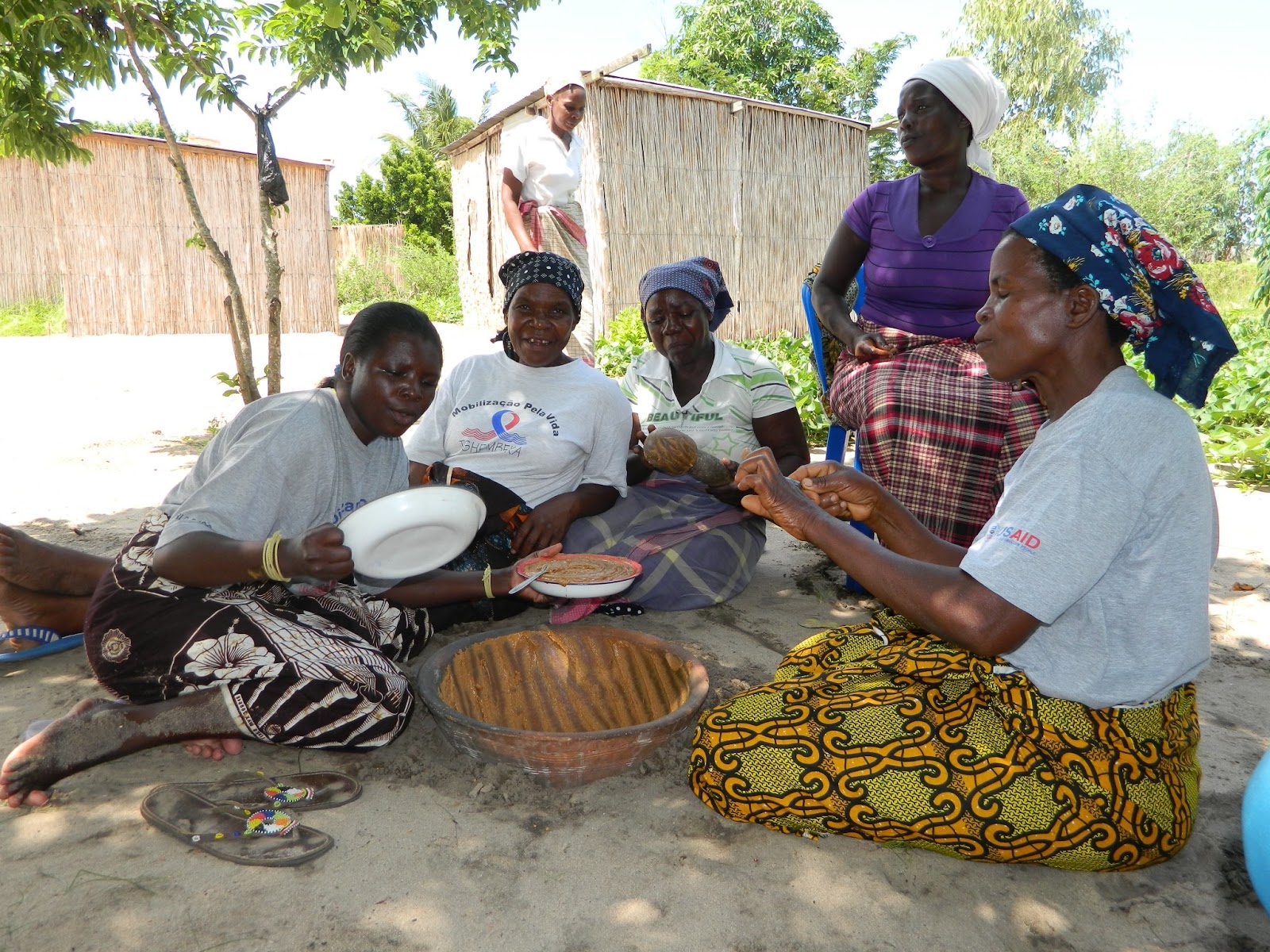
Four activistas: Antoineta, Alcina, Josefa and Marta all came to make peanut butter the first time. When we arrived, we sat outside the office on straw mats and started de-shelling the peanuts we brought. I did a little talk on all of the steps to make peanut butter and why it is a good source of energy and protein. Then, we went through the following steps:
1.     De-shell the peanuts
2.     Take out any bad peanuts
3.     Roast the peanuts with sand in the bottom of the pan
Alcima roasting the peanuts. 
Antoineta taking the red shells off the peanuts.
4.     Take off the red outer covering of the peanuts
5.     Crush the peanuts
6.     Mix the peanuts in a clay bowl to a make a smooth butter-like consistency
The activistas taking the red shells off the peanuts.
Alcima, Marta and Josefa making peanut butter.
7.     Add a little bit of salt and sugar to taste
8.     Bom Apetite! Enoy.
The weather was a little dreary that day so we kept moving between being outside in the yard to the covered kitchen area depending on the rain. But, the process went well.  I didn’t have to teach any of the women how to do the steps we were doing because they were all techniques they had done hundreds of times before. They had just never done them with the end objective to make peanut butter. They not only worked hard throughout the process, but also celebrated the steps by singing songs in Changana. Upon completion, we were able to fill enough little jars for everyone to take some home. As we were filling the jars, one of the activistas was literally licking the bowl clean, she turned to me and said in Portuguese, “Colleen, we are going to develop Chicumbane with this peanut butter.” Maybe, just maybe, I thought. As we ate our lunch of peanut butter sandwiches, they brainstormed how they could sell these peanut butter sandwiches on the road to kids as they go to and fro school. We decided to meet again the following Thursday to invite more activistas to learn how to make peanut butter and to try a little experiment of sales, to see if people would actually buy the sandwiches.

On Thursday when Antoineta picked me up at my house to head to the office, she told me how her son had asked if she could go buy more of the peanut butter they had. She said how she told him she couldn’t buy it, but was going to make more with Mana Colleen. They had finished the jar she brought home in less than a week. That Thursday, twice the amount of activistas showed up to work. While we sat taking out the bad peanuts, this time Antoineta gave the talk on the steps we would be following and why we were making peanut butter. I don’t know if it was because we already knew what we were doing or what, but the process seemed to go a lot faster and smoother. And the peanut butter turned out a lot smoother too. When it was ready, we called some of the neighbors in the area to come try it. They loved it and actually started dipping some cassava we had in the peanut butter. We set up a chair on the road with some pre-made sandwiches and some of the activistas said they would sit there the rest of the day to see what kind of interest it generated. They decided they would sell a half peanut butter sandwich for 2MTS. Just for reference, $1 USD is equal to 30 MTS.  I felt like we were setting up an African version of a lemonade stand. The women were excited to see if people were interested in their new product, but I think they were most excited that if at the end of the day, there were still sandwiches left over that they would be able to eat them. 
Antoineta trying to sell some of the school kids on peanut butter.
Clean-up crew


TSHBEMKA Activistas and neighbors of the office trying peanut butter. 


Tuesday, March 5, 2013

Comings and Goings


Mel’s first litter has already come and gone. Those six weeks flew by; they went from looking like little rats confined to the outdoor kitchen sleeping all day to running, playing and barking all over the yard. I started giving them real food, well, real dog food being xima with either dried fish or cooked chicken insides two weeks ago. They have been growing incredibly well and even getting fat. Some of my neighbors who knew Mel’s other litters said this one, by far, had the biggest, healthiest-looking pups. However, it was also her smallest litter with only five puppies. Her others had eight and nine. I received a number of requests for puppies from my neighbors, the kids who come to color, primary and secondary school teachers, hospital colleagues, activistas and other Peace Corps Volunteers. It was hard to decide who would actually be getting the puppies. I also unfortunately lost one while I was away at trainings in Maputo and Manjacaze last week. Nelio, my neighbor, was also at the training in Manjacaze all week. Dona Rachel was taking care of Mel and the puppies. On Wednesday, she called me to let me know that in the morning all five puppies were there, but in the afternoon there were just four. There wasn’t much I could do while I was away, but when I got back, I tried to conduct my own little investigation. The one missing was actually the one Nelio had claimed to keep. He had named it Buddha because he was male and the fattest. When I asked Dona Persina, my landlady, about the missing puppy, she said that when her dog had puppies, the biggest male also went missing. She said it didn’t seem likely that a puppy would run away when they are so dependent on their mother at that age. Could there be a Chicumbane puppy thief? Another neighbor told me he saw Mel carry a dead puppy in her mouth back to my veranda and left it there. I never found it. But, this was also around the same time that Mel brought home a dead piglet. So I wonder if he confused the piglet for a puppy. Regardless, neither was pleasant. But, that’s just one of the differences between dogs in Mozambique and America. So with just four puppies to give away, I gave one to Nelio’s aunt; one to Louis, my supervisor at the hospital; one to Antoineta, an activista with TSEMBEKA, a community organization here in Chicumbane; and one to João, one of my activistas at CACHES, to give to his mom. I kept a list of all the people who requested puppies to have for the next litter.

Dogs in Mozambique do not have the longest lifespans so in order to do everything I could to support them in their new homes, I wrote up little info cards in Portuguese with everything I learned about having my first litter of puppies and what they should continue to do. I included fun facts like: Don’t give dogs raw meat because it will make them hunt down chickens and other animals (which won’t make your neighbors very happy) and to bring them to the vet in Xai-Xai at six months in order to receive proper vaccination.   I also included some flea medication I had and a piece of the towel that stayed with the litter for the first six weeks. All except one of the new puppy owners came to pick up their dogs this week so already the yard is incredibly quieter.

I kind of miss having all the little guys running around. But, with their departure, there was a new arrival in Chicumbane! I now have a site-mate!! One of my colleagues, Heather Blair, a Moz 16 volunteer was relocated to Chicumbane after her site, Chalucuane, was affected by the floods. After spending a month in Maputo, she moved to Chicumbane last Thursday. Her site was hit pretty hard by the floods. Before moving, she went to her site to salvage what she could. There was not much she could take because the water had entered her house up to two meters high. What she did recover, she spent the first few days here cleaning to remove all the mud. She has been living in my house, while her new house is still being prepared. They still have to build a new latrine, replace windows and change the locks. When her house is ready, she will live just a short ten-minute walk from my house in the same neighborhood, just across the street from Nelio’s aunt.

Heather is a Moz 16 volunteer so she just has five months left in her service here in Mozambique. She also works with the Elizabeth Glaser Pediatrics AIDS Foundation so she will be working at the hospital with me. At her old site, she worked with her counterpart to set up GAAC. GAAC stands for Grupos de Apoio e Adesao Comunitaria and they are groups of six people who live in the same neighborhood and are all HIV positive. Instead of having to go to the hospital every month to pick up anti-retrovirals, just one person from the group goes each month to pick up the ARVs. This way, each person only needs to go to the hospital every six months. Right now the hospital here in Chicumbane has 52 groups. Heather will be working with Enfermeiro Ricardo to improve our current GAAC system. I will continue to work at the hospital on the projects I have been doing: support groups in PTV and CCR, nutrition and papas palestras in CCR, organization with the files and in the database. We hope to work together on some projects as well. We will just have to keep in mind what is realistic to accomplish in five months. It is definitely a strange time in one’s service to have to pick up and totally relocate sites, but I think Heather is excited about being here in Chicumbane. She fondly goes by “Mana Hea” and the criancas are already getting used to having her around. As we have been going around introducing her at the hospital and the neighborhood, there was a little confusion about whether she was replacing me because the last time they met a new volunteer it was a substitution. But, I told them they were stuck with me until 2014. 

Tuesday, February 12, 2013

Six Months In

            February 12th marks six months at site. While at times the days seem long, looking back, the past six months have flown by. I have no groundbreaking news or projects underway just yet, but certainly a lot has happened. The first six months are the integral period of integration. And throughout this time, to be honest, I have probably seen the biggest changes in myself. During this period, I have given several baptisms (Baptisms are what my organization CACHES likes to do on peoples’ birthdays. They just douse the birthday boy/girl with a bucket of water), attended three funerals, learned how to properly tie my capalana, built a reed wall, watched my latrine sink in—thank God, I was not using it at the time, learned how to “tomar cha” without actually drinking tea, learned how to fill the holes in my floor to keep out the rats, tried canhum (traditional Mozambican beer made from fruit) and developed the best response to marriage proposals and the like. There have been great days, not-so-great days and everything in between. I have turned 25 (AHHH), traveled within three provinces of Mozambique and two neighboring countries, become competent in one language and am learning a third, learned to actually cook meals for myself, perfected the bucket bath, become comfortable with the Mozambican schedule and learned a dance move or two along the way. Every day is full of surprises. And along with that I have surprised myself with my ability to just sit and wait for sometimes hours on end. I have developed a new tolerance for the lizards, rats and creature features that inhabit my house with me. The lack of personal space in this country no longer comes as such a surprise, but rather, just the norm. I would like to think I have become more resourceful and self-sufficient, along with that more independent and maybe even a ‘lil bit sassy—you have to be here in order to stick up for yourself. There continue to be challenges and new things I struggle to understand every day. But, this is to be expected. Things like why do Mozambicans spend so much time raking the sand in their yards and why chefes (bosses) have such a macho man mentality and why its okay for married couples to have other boyfriends and girlfriends?  But, this is still just the beginning of my service, and over the next year and a half, I will continue to try to understand. For now, here’s just a few take-away’s from the past six months:
·         In the kitchen
o    In the states, when I was in grad school, there were many a nights that I would come home starving, pop a veggie burger into the microwave, heat up some brown rice with frozen veggies and call it a meal just five minutes later. Instant gratification. Such instant gratification doesn’t exactly exist in Mozambique. But, I have learned to adapt. Now my diet includes cinnamon lentils, feijoada, cucumber curry and sweet potato curry. I never did this much cooking in the states.

When groups of volunteers get together, we always joke, “Hey, let’s just order pizza.” Well, that’s not exactly an option. But, again we’ve adapted. And a large part of hanging out is usually spent cooking together. My palate has definitely changed as a result of that. I used to have no tolerance for spice. Mild all the way. Seriously. But, since being in Moz, I have started to experiment a bit with peri peri (hot sauce)  and even branch out to eating spicier foods, really just new foods in general. The first time I had Indian food was here in Moz and I recently tried bunny chow in Durban. Bunny chow is basically a quarter of a loaf of white bread that they then dig out the center and fill it with curries. While it definitely had quite the kick, I actually enjoyed it.
·         Resourcefulness
o    Two weeks ago when I was in Maputo, the air conditioner in our room didn’t have a knob to adjust the level of coolness. I used my tweezers to grab the part that stuck out and was able to then adjust the levels. We kept my tweezers there for the duration of our stay. I felt like a Peace Corps Volunteer. Many Peace Corps Volunteers pride themselves on such resourcefulness. I feel like I am perfecting that skill as well.  I have rigged a hand washing station in my kitchen using an old water filter.  I recently took a broken cabinet door and made it into a bulletin board.  I no longer write anything off as trash. There could always potentially be another use for it; it is just a matter of finding what that may be. And this resourcefulness is not only with objects, but with people and connections as well. There is quite of system of support available here; it just takes tapping into the right resources and knowing who to call and when.
·         Language
o    Kotsungo-kutsongo. Pouco a pouco. “Little by little” in Changana is my go-to phrase when my neighbors, patients at the hospital and other community members test me on my knowledge of the local dialect. I have never been good at learning languages. My seventh grade Spanish teacher would attest to that. And to think, that now I can live in Mozambique speaking Portuguese and am working on learning the local language. While my Portuguese is far from perfect, I can communicate with my neighbors, counterparts and community members. I am now giving talks about nutrition in Portuguese at the hospital that a volunteer then translates into Changana. I do not think I will ever be able to fluent in Changana, but I am trying and everyone in Chicumbane gets a kick out of the few phrases I know. In training six months ago when I was struggling with memorization of correct verb conjugations and even just basic Portuguese pronunciation, I never thought I would be as competent as I am now. Despite the progress I have made, there are still days I get frustrated, but kutsongo-kutsongo, I am getting there.
·         Patience
o    Horario Mozambicano. Professor Mario, the Coordinator of Programs at CACHES constantly reminds me of the Mozambican schedule. A meeting is scheduled for 7 p.m., hardly anyone is there before 7:30 p.m. Be patient with us, he then says. What he doesn’t realize is how I was a pretty patient person before I came to Mozambique and I have only gotten more patient being here. Somehow, I can just sit for hours not really doing much waiting for people to show up or meetings to start. While I can’t say that I totally understand why there is such a lag time, but I have definitely adapted to it. Whether I spend the time reading, making lists, or just thinking things over, I have learned to just to sit and be. And along with that, I have noticed myself slipping into a Mozambican schedule. I used to get nervous in the states when I would be more than five minutes late, but here I have found myself running late or just losing track of time. But, you know what, I am okay with that.
·         Dance moves
o    I didn’t know what else to use as a subtitle to classify the cultural experiences I have every day. The main goal of Peace Corps is cultural exchange and I can definitely say this is a regular part of my day. Not only have I introduced the kids at CACHES to Halloween and Thanksgiving, but I have also had thought-provoking conversations about the meaning of marriage in the United States and why people don’t use the N word. And then there are the days when your neighbor picks up a bird that fell off your roof and asks you if you are going to eat it, then puts it in his pocket calling it “carne” and you are pretty sure he has the intention of eating it later. Some things just don’t translate. But, then other days you have really good exchanges. At the hospital, because some of my colleagues want to practice their English, we have developed a schedule: Monday, Wednesday, Friday we speak English; Tuesday and Thursday we speak Portuguese.

 Every day is a learning experience for all of us. I am sure that when seven of my fellow PCVs were at my house for the weekend and we decided to have a dance party out in the pouring rain, my neighbors first just called us crazy malugos (white people). But, then slowly, one by one, we got them to dance with us and we all had a good time. Two hours later…we were soaked. But we had fun. And we taught each other a move or two along the way.  Just as the saying goes, “Life isn’t about waiting for the storm to pass; it’s about learning to dance in the rain.” –Vivian Greene